
Tips & Techniques
 Previous
The Drawing Tools I Use
I am often asked about the tools I use to create my drawings. Do I use traditional wood-cased pencils or mechanical ones? What type of eraser do I use? It would appear that many Artists have a fascination (and a vested interest) in the tools and techniques used by other artists... and I'm no different in that respect! So, what tools do I use......
Click any item for a full description of its uses and properties








- Clutch/drafting pencils or lead holders
- Stylus for indenting / incising
- Graphite leads for clutch pencils
- Progresso solid graphite pencil
- Wood-cased graphite pencil
- Stump and Tortillon for blending
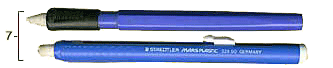
- Soft art erasers in holders
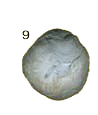
- Soft art eraser
- Blu-Tack used as eraser
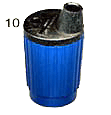
- Sharpener for clutch pencils
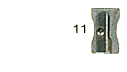
- Sharpener for wood-cased pencils and eraser cores
- Colour Shaper
Brushes...

Never brush eraser crumbs or dust off your drawing using your hand. Keep a brush or two handy for such jobs so your drawing doesn't absorb oil from your skin. And don't blow dust off as you risk moisture marking the surface. I keep the big 1" brush for general cleaning of the drawing surface and the red-handled brush lives behind my ear - it's readily available for removing eraser dust whenever I need it.
Pencils...
Almost since the day I started drawing in earnest, over 20 years ago, I have eschewed the use of conventional, cedar-cased pencils. They have their place and many artists use nothing else but I use only one (6B) - and then infrequently. Why? Well, there's little worse than using a tool that continually shifts its size and weight and I don't see any advantage in drawing with a tool that has to be constantly relearned. On the other hand the mechanical pencils that I use possess none of these faults and many advantages.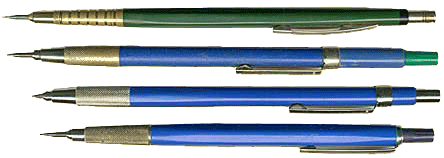
The green pencil at the top is from Faber Castell but most of mine are made by Staedtler. From the top downwards the grades of these three are F, HB and 2B. How do I know? Because each pack of leads include a colour end cap to fit on the holder. You will see that F has a green cap, the HB has its original chrome cap and a purple one is fitted to the 2B. If you're buying for the first time I suggest you purchase just three - 2B, HB and 2H - these will achieve almost all the effects you might need.
Progresso pencils

Progresso pencils are solid sticks of graphite and very versatile tools. However, although I keep both 2B and 6B I rarely use them except for outdoor sketching and for lightly washing tone over an incised area (see Incise tool).
Wood-cased pencils

Usually cased in Cedar, these pencils possess a lightness that can aid subtle shading techniques but suffer from a number of disadvantages. They shorten in use resulting in an ever-changing balance and weight; a variety of points can be achieved but very fine points tend to require the use of an emery board or other rough surface to achieve this - clutch pencils possess a needle-point by default. If dropped or bent the graphite has a tendency to break internally - clutch pencils support the lead internally with virtually no breakages in normal use.
Graphite leads...
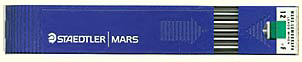
Staedtler 2mm diameter leads are available in tubes of 2 and packs of 12. The 12-pack (illustrated above) comes complete with a grade-dependent colour-coded end cap for your pencil. The leads are fully supported within the pencil by an internal brass tube.
A wide range of grades is available of which the most useful, from softest to hardest, are 6B, 4B, 2B, HB, F, H, 2H, 4H and 6H. The softest I use is 6B although I use it infrequently - being coarse-grained the individual grains of graphite tend to be visible, which can distract from the reality that I'm trying to achieve. In normal use my softest grade is 2B and my hardest 4H. Most of my drawing is achieved with just the three grades of 2B, F and 2H.
Indenting stylus...

 Used for impressing a line into paper before drawing commences. It produces a clean white line with parallel sides and (with practice) a perfect tapering point. Uses include the cat's eyebrow whiskers as shown here. The tool is home-made and consists of a darning or sewing-up needle (round, not pointed, tip) with the eye snapped off and inserted into a spare clutch pencil. Once the lines are indented I use the 2B Progresso pencil to lightly shade over the area to reveal their positions during later work.
Stumps and Tortillons...

Used for blending graphite. Stumps are generally double-ended, larger and bulkier than the finer single-ended tortillons. Both have their individual uses although I tend to use only tortillons - for coarse work I wrap kitchen paper around my finger and use that instead. Never use your unprotected finger to blend graphite. The natural oil in your skin will cause graphite to stick to your paper in irregular patches. It once took me two days to constantly tone and blend around such an area before it became unnoticeable...
A wide range of grades is available of which the most useful, from softest to hardest, are 6B, 4B, 2B, HB, F, H, 2H, 4H and 6H. The softest I use is 6B although I use it infrequently - being coarse-grained the individual grains of graphite tend to be visible, which can distract from the reality that I'm trying to achieve. In normal use my softest grade is 2B and my hardest 4H. Most of my drawing is achieved with just the three grades of 2B, F and 2H.

 Sharpeners...
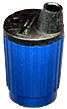 If you are drawing with clutch pencils the Staedtler sharpener (shown right) is a "must have" item. Purpose made to sharpen the leads inside these pencils, it is capable of producing needle-sharp points if required. On top is a lead cleaner (a fibrous insert into which the sharpened pencil point is pushed to clean it of loose graphite powder) and, to either side of this, are two small holes — extend the lead into either to obtain a set length - one gives a sharp point, the other a standardised blunt tip. You can also save the waste graphite and use it with a brush for gentle toning - although I don't personally use the method, preferring the greater control offered by the gradual building up of lines of graphite for blending. The conventional sharpener shown above is used not only for sharpening wood-cased pencils but also to obtain very usable points on stick erasers (see below).
Erasers...
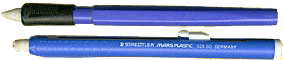
A wide variety of conventional erasers exist but I only use those shown here. The main requirement is for a soft eraser that can gently remove graphite and not grind it ever deeper into the paper's surface.
 It is for this reason that I no longer use ink or typewriter erasers. Apart from the block eraser (shown right and that I only use for cleaning the margin around a drawing on completion) I make most use of Staedtler's stick erasers. Of the two versions shown above I use the top one — although this is now unavailable the 528-55 refills for the 528-50 below will fit the old (and more comfortable and precise) holder. The eraser core is capable of being formed to a very fine point using a conventional pencil sharpener.
Blu-Tack
as an Eraser...
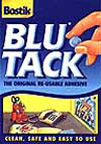
Due to many requests Mike Sibley Fine Art now supplies
Blu-Tack worldwide.
Click below for prices, shipping details and order form.
Blu-Tack worldwide.
Click below for prices, shipping details and order form.
Accept no alternatives. Blu-Tack is not widely available outside the UK and I have received many reports on similar products, such as Hold-Tu and Tack'N'Stick. I invariably find Blu-Tack to be superior because it possesses a tackiness not inherent in other products, which tend to be only as useful as a normal kneadable eraser.
"The Blu-Tack is better than I even thought it would be...I'm still amazed at how that light touch will pick up the graphite. It's great!!!!"
"I just received the Blu-tack... and it really is fantastic! I am working on a drawing, and as soon as I tried using the Blu-Tack, what a difference! I have about 5 other brands of tacky stuff and nothing works like this! And you are right that it gently lifts the graphite without ruining the original pencil marks. I love it!"
Toby Levin, USA
"I just received the Blu-tack... and it really is fantastic! I am working on a drawing, and as soon as I tried using the Blu-Tack, what a difference! I have about 5 other brands of tacky stuff and nothing works like this! And you are right that it gently lifts the graphite without ruining the original pencil marks. I love it!"
Sherry Szmigiel, USA
TOP TIP
Do not discard old stumps and tortillons.Worn tortillons saturated with graphite can be used as "pencils" in their own right. I often use them to add delicate tone and to randomly sketch indistinct backgrounds.
Available here...
320gsm super-smooth Brilliant White paper
The ultimate versatile kneadable eraser
288 pages of drawing techniques and more...
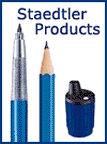
Pencils, Starter Packs and accessories...
320gsm super-smooth Brilliant White paper
The ultimate versatile kneadable eraser
288 pages of drawing techniques and more...
Pencils, Starter Packs and accessories...

