
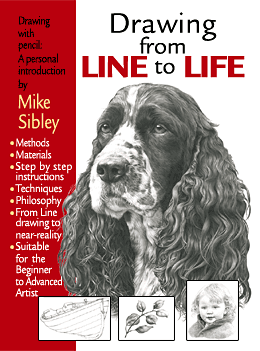
Drawing from Line to Life
Now shipping
PRIORITY MAIL in USA
No extra charge
PRIORITY MAIL in USA
No extra charge
Now shipping
PRIORITY MAIL in USA
No extra charge
PRIORITY MAIL in USA
No extra charge

- Many artists' "drawing bible"
- Foreword by renowned artist David Shepherd
- Over 280 pages of drawing tips, tutorials, demonstrations and much more...
- More than 625 illustrations
- Tools, techniques, methods
- Step-by-step instructions
- For the Novice and Advanced student
- From pure line drawing through to near-reality
If you're a graphite artist or an artist who wants to learn more about how to construct a drawing, a book like this is a jewel. "Drawing from Line to Life" is the book I have been waiting for... a book where a life-long artist performs a magical brain-dump into a format where you can reference it your whole life. So, if you were on the fence about this book think about it this way: this book can help you perfect your craft for a lifetime and amounts to a night out to a restaurant and a few drinks. Now ask yourself, which is going to stay with you after you wake up the next day?
Rich Adams
—— CONTENTS ——
Section 1...
Foreword
Read eminent and renowned artist David Shepherd's foreword to Drawing From Line To Life.
Line to Life
An introductory explanation of the sections of the book and the many different ways of working.
Tools
The different types and grades of pencil available and hints on their uses. Erasers, indenting tools, sharpeners, blending tools, hand-guards, paper types and brands, and more...
Line drawing
How to draw using line to describe the edges, outlines and internal features of a variety of subjects. Learn to see the basic building blocks within an object, which will greatly simplify its construction. And more...
Tone drawing
Also known as 'Value drawing'. Drawing without using line and depending purely on tone, and interpreting what you see in terms of tonal values and textures. Includes many different methods.
Erasing
The different types of eraser and how to use them. How to draw with an eraser, and effects that erasers can achieve. Kneadable erasers, Blu-Tack, vinyl art erasers techniques and more...
Blending
How to blend and layer graphite and when to use which method. Features a variety of techniques with demonstrations.
Indenting
Make your own stylus or use available tools. Direct and indirect indenting, when and how to use it - and when not to - with working examples.
Step-by-step 1
See the drawing of young Charlotte in twenty five stages with notes written at the time - the triumphs and trials!
Section 2...
Fooling the brain part 1
Negative space and other ways to fool your brain into letting you work without its interruption, and how to properly perceive what you see.
Working from photos
Tips, tricks and the many uses you can make of photography. How and when to use photos as reference sources and how not to let them dictate content.
Negative Drawing
A comprehensive look at drawing in negative. A technique that allows you to break your drawings down into manageable sections and layers, and one that protects the white of you paper until you decide to add tone or not.
Perspective
How to see and construct one and two point perspective. Also includes more advanced techniques such as ground plane perspective.
Light and Shade
The Laws of light and how they dictate shades and shadows - and how to lie effectively if the Laws don't suit your situation. Includes the description and use of all shadow types.
Fooling the brain part 2
How to fool your viewer's brain by making it see more detail than is actually present. Includes many useful tips, tricks and techniques.
Transfer techniques
The many and varied methods you can choose to transfer your sketches and plans to your final drawing surface - or to transfer them directly from source material. Covers gridding, projection, tracing and much more...
Preparation
How to prepare your drawing before you begin. Includes concept drawing, sourcing, planning ahead, composing with multiple sources, etc...
Step-by-step 2
See the drawing of a Tortoiseshell cat unfold in twenty five stages with notes written at the time - warts and all!
Section 3...
Drawing Ellipses
How to draw true ellipses by eye, and common errors to avoid. Also includes how to draw very large ellipses on any surface from drawing paper to walls.
Drawing Textures
Explains the basics of reproducing textures in general with a selection of demonstrations - brick, textiles, wood, and more...
Drawing Reflections
What to look for when drawing reflective surfaces and how to turn your findings into believable interpretations. From classic cars and ceramics to water.
Drawing Foliage
How to draw background, midground and foreground foliage from grass and weeds to bushes and trees. With demonstrations of techniques.
Drawing Hair
An in-depth look at the drawing of many different types of hair and fur. The techniques are applicable to humans and animals alike. What to look for, and how to interpret and draw it.
Drawing Features
The basics of drawing eyes, noses and other facial features. With an explanation of the many different eye types and shapes from horses to humans.
Section 4...
Put it all together Step-by-step 3
Follow one of Mike's drawings, produced especially for this book, from concept to completion. Features Maisie, his Parson Jack Russell pup.
Index
A comprehensive, cross-linked index, makes this book as much a reference source as a drawing tutor.
Join my Mailing Lists for news...
Choose any or all:
Books & Videos
Online Courses at Drawspace
Workshops : UK, USA, and Canada
Artwork & Prints
Online Courses at Drawspace
Workshops : UK, USA, and Canada
Artwork & Prints

