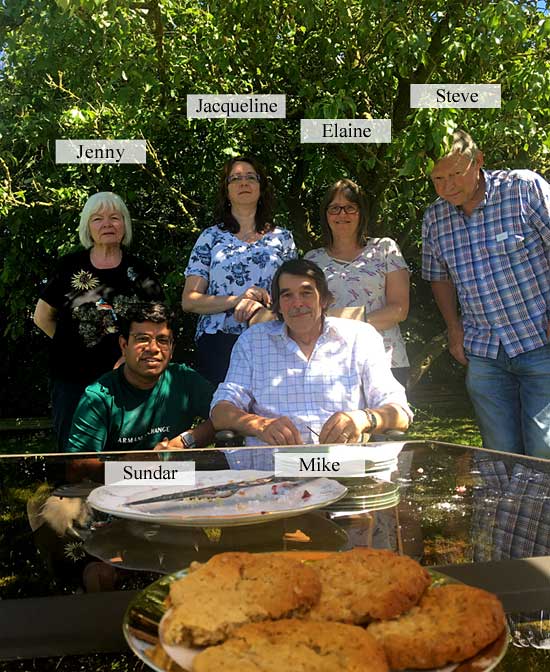
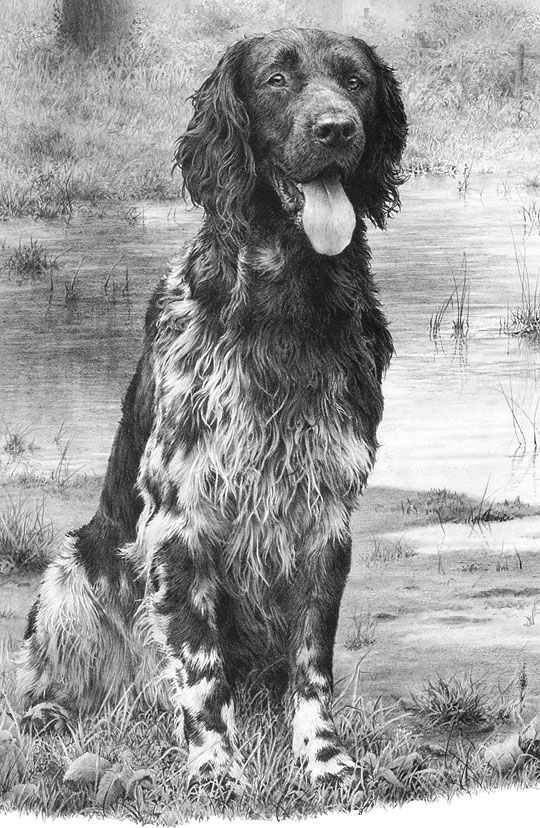
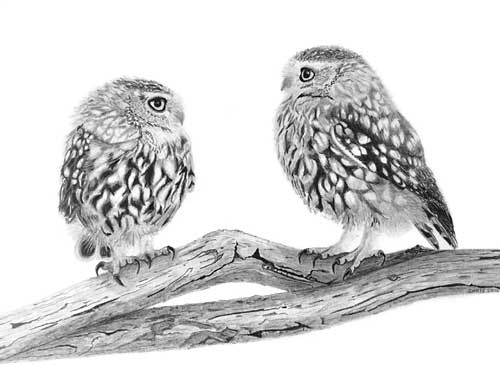
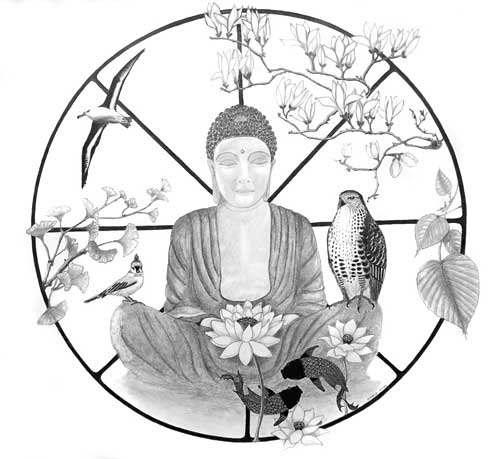
What a wonderful weekend we had here in my studio… running the Drawing Animals workshop for the first time. To find out when I’m running it again (UK/USA/CANADA) read on…
Really lovely company and weather too, and lunch in the garden on both days. All the cake’s gone, but I’ve still got cookies for supper! 🙂
June 2018 DRAWING ANIMALS workshop
I’ll be running this workshop in my studio again in October (20-21) and, as a 3-day workshop, in:
OTTAWA, ON – August 17-19 Limited places now available
and
CLEARWATER, FL – August 24-26 Only ONE seat remaining!
I sometimes answer drawing-related questions on Quora. This is my latest post in answer to the query “DO I NEED TO DRAW FROM LIFE IN ORDER TO GET BETTER AT DRAWING?”
I’ll assume by “draw” you mean the use of graphite pencil, and that the drawing includes both line and three-dimensional shading. A realistic, or semi-realistic, end result being your goal.
Because the pencil is a relatively narrow, pointed stylus, we tend to be detail-orientated artists. We don’t have the facility to lay down broad areas with a quick gesture, so spontaneous “suggestion” is rare. Instead, we concentrate on the finer details.
To do that you need to know what the details are. You cannot successfully draw something you don’t understand. That understanding, and the knowledge of the detail, comes from observation. You store individual elements in your brain and subconsciously retrieve them as you work. Drawing from life is an excellent way to load data into your brain, because it forces you to focus on the make-up of your subject. And the more data you store, the easier drawing becomes.
You can gain similar information from photos too, or just by looking at something in real life. But the act of drawing reinforces the memory of its parts.
You can test your ability to recall quite easily. And this exercise is a good one to run through before you draw anything. Use words, not drawing – describe the object to yourself. Take a leaf: you know its shape but is it flat? Or does its surface consist of rounded and raised islands? Are the intervening veins lighter or darker than the body? Do the veins sink in to the upper surface or stand proud of it? How does the underneath surface differ from the top? Drawing from life helps to answer those questions, and commits the results to memory. The next time you draw a leaf, you’ll have all the information you need to draw it confidently and realistically.
Sometimes when I’m drawing foliage I find my store becomes depleted. No problem. I grab a sketchbook, walk to the nearest leafy lane (which I fortunately live on) and sketch individual leaves. Now, armed with an array of different shapes and forms, I can inject a greater sense of reality into my drawing.
Photos are good sources of detail, but they won’t supply much three-dimensional information.
Pure observation will help to analyse textures, form, and detail, but the memories might fade in time.
Drawing from life – even simple line drawings – will explore all aspects of the subject. You’ll remember your drawings, and their constituent parts, far more clearly and permanently. And, if you reach out and touch the subject, run your fingers through its hair, feel its glossy smoothness beneath your fingertips, scrape you nails over its rusty surface… you’ll remember all that too. It’s all “brain food” to feed into your future drawings.
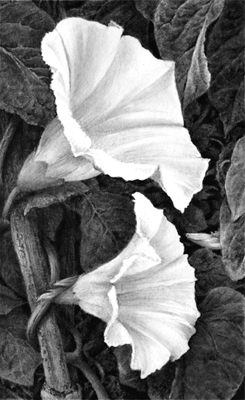
This is a little 2″ x 3″ (2.5 x 7.5cm) drawing drawn from my imagination, but I was drawing what I knew and understood – recalling information supplied by various earlier life studies.
Bindweed
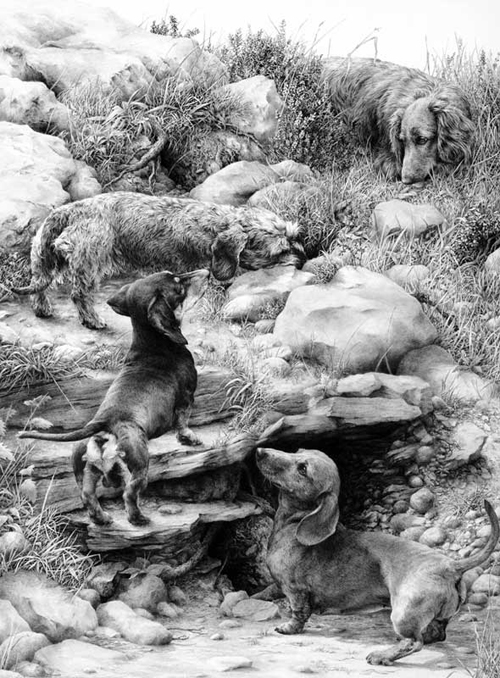
Or here in “The Warreners”:
The Warreners
I worked from photos of the dogs, although I had stroked and got to know each one. The rest is imaginary, but that was only possible because of earlier drawing from life – I know how grass springs from the ground; how heather forms into slim, angular branches; how sandstone is formed, and limestone rocks are altered by water action.
The human brain loves images. Draw what you see – convert your vision to an image – and you’ll remember everything about it for years to come.
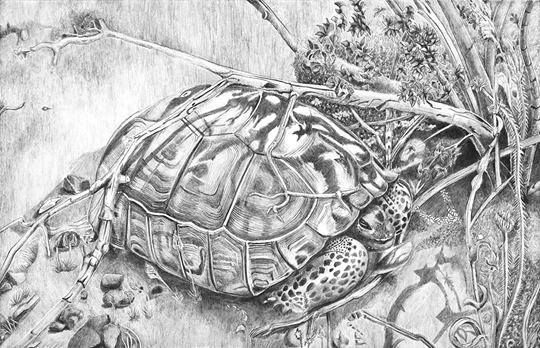
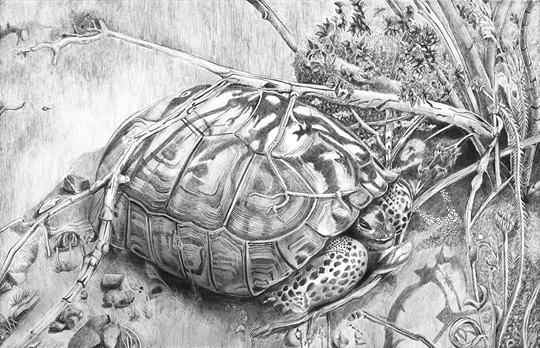
Having offered some advice to Jay on an earlier project he emailed me again with his latest drawing – “Mojave Terrapin”. In Jay’s own words:
Our discussion centered around modifications to values as a drawing progresses. I had significantly enhanced the shadows over the photo reference I had for this image. I worked to enhance the darkness of shadows from the branches of the bush the Terrapin was under as well as darken the shadows under the turtle. I am a little disappointed that I didn’t even go darker.
MOJAVE TERRAPIN by JAY SULLIVAN
I’m disappointed too, Jay. My first reaction was that my eye goes straight to the black hole at the right. My eye going there first is not too bad because I’m quickly taken to the Terrapin, but the lighter values used for the Terrapin do make it look rather flat. I don’t think the lighting is helping that either.
Judging from the shadows across the Terrapin the light appears to be very even across the shell – but I think you can use artistic license to lie about that convincingly.
May I suggest you progressively darken the left-hand side of the shell? That would increase it’s three-dimensionality. You could also echo the value of that black hole at the back of the head, where it disappears into the shell. It’s another “hole” so it should look natural. And all that might then allow you to further darken the shadow cast by the shell. There appears to be a lot of white in this drawing that needn’t be there.
Having done that you might then have to darken the ground, but I think it can withstand that – and it would help to separate the ground plane from the vertical one behind.
I’ve had a very quick attempt at adjusting your image – darkening the places I mentioned with Photoshop to show you what I mean:
Altered image
Jay replied this morning:
Thank you for your insight. You confirmed and certainly went beyond what I was thinking. Your feedback is invaluable to me.
In my head I had finished the drawing. So I’ve been working at getting over being done with this drawing. One of my realizations is that I have fallen into a habit of not exploiting value for the best result. The terrapin is an example of creating an overall pattern that is too light even when I was trying to be more extreme in using dark to create contrast and emphasis. It is a wakeup call to increase my extremes and watch more closely the overall effect on the drawing. I think a part of cause of this pattern is that I’m not viewing my work at a distance enough. With my nose to the paper I’m working up close and fail to see the effect from a distance unless I put the work across the room for a good look at the whole thing.
I completely understand that. On completion your head will be so full of the individual details that it’s almost impossible to see the drawing as a single entity. My solution to that is to put the drawing away for a few days – or until I can’t exactly remember everything about it. Then I go through a strange ritual. I take out the drawing (face down) and fix two pieces of Blu-Tack to the top corners. Then, without looking at the drawing, I stick it to the wall of my studio and walk away from it. When I turn round I’m too far away to see detail and I get to experience the drawing in the same way everyone else will.
Sometimes I’ll notice a tonal imbalance, or perhaps an element that is distractingly prominent. Then I’ll find a way to fix it with the minimum of work – not because I’m lazy, but if I make changes that are too drastic I’ll quite probably unsettle something else.
Finally, I’ll decide that the drawing is as good as it can be, given my current abilities. I know it can be better, but going beyond my abilities at that late stage will create more problems than it can solve.
One artist commented that drawing is vastly different than painting. If I was being judged by brush wielders they might see my work as incomplete. Pencil artists see white or negative space differently. These differences in perception influence lighting. Trying to apply painting criteria to drawing breaks down over issues of negative space.
I totally agree. You can perhaps best compare drawing to watercolour painting, since both have only the white of the paper available. In my workshops and online I try my hardest to get the artists to see the negative space positively. Two pencil strokes can leave a very usable white shape between them, and we pencil artists need to be constantly aware of the white spaces we are creating. I often find those spaces suggest something that I wouldn’t perhaps have consciously thought of, yet the space works well – especially when refined to become a specific positive element.
Jay continued:
I remember your lesson about negative space, focused on drawing grass. I’m trying to work through how to apply this lesson to contrasts between different foreground/background values like the shell of a terrapin and a stick he is under from a bush nearby. Shadows help with separation. At the same time, exaggerating the value differences between the stick and the light grey of the shell creates an artificial contrast making for greater separation of objects.
Your thinking is 100% accurate. Never be afraid of exaggeration. I do it all the time. False atmospheric perspective, for example, that exaggerates depth. I see drawing as a collection of visual clues that we supply to our viewers. If a little subtle exaggeration is required to add clarity to the clues, then I’ll apply it. We don’t have colour – we can’t add blue to create recession – so I use diminishing detail, softening edges, and lighter values that are often lighter than would naturally occur. Ultimately, all that matters is that the drawing is “read” correctly.
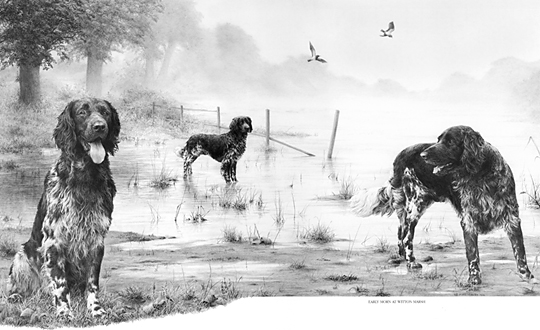
Here are two examples within one drawing “Early Morn at Witton Marsh”.
Early Morn at Witton Marsh
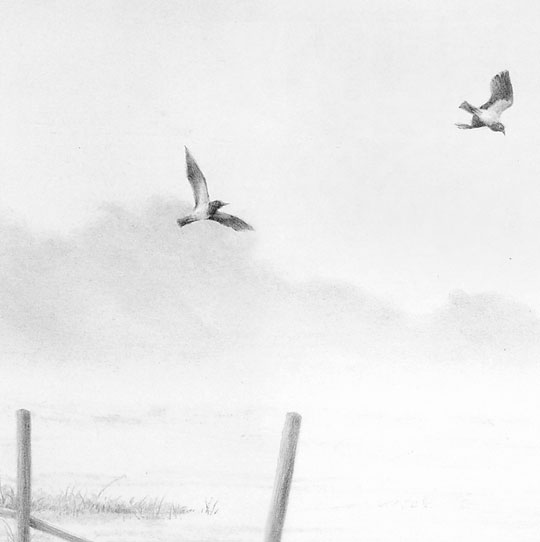
The atmospheric perspective has been stretched to create more recession, and the two birds are deliberately placed to enhance the gap between background and midground – contrasting their relative sharpness against the soft, misty trees and sky.
Detail from Early Morn at Witton Marsh by Mike Sibley
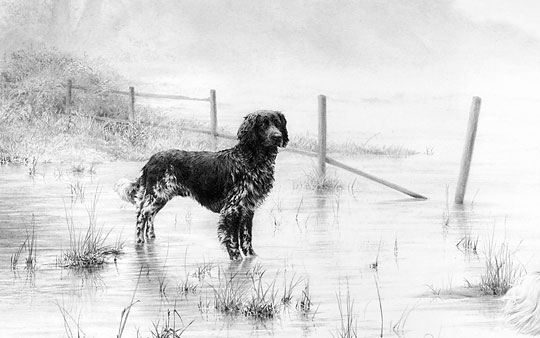
Lower down, the central dog is larger than it should be. It was sized for balance and presence rather than natural accuracy. To overcome that, the fence behind it has a false perspective – it recedes more quickly than it should. But it provides scale alongside the dog and then seamlessly connects that to the scale of the brush and trees behind it.
Detail from Early Morn at Witton Marsh by Mike Sibley
And to return to Jay’s original point, all the hair depends entirely on negative drawing – all white hair is purely negative space. The adjacent drawing defines the edge
detail – “Early Morn at Witton Marsh” by Mike Sibley
Dear Mike, Drawing with graphite pencil gives me a lot of pleasure and happiness. In the past using color made me more and more feel like I was losing contact with my work and the pleasure disappeared. But since I removed color from my drawings people keep saying: “Why don’t you use color? You have to use color, that’s much more beautiful” and so on. Probably you have had these comments too. Could you please give me any advice what to say to these people so they stop nagging?
Leaning against one wall of my studio are two pristine stretched canvasses. One drawer of the unit containing my drawing materials is full of unused oil paints, palette knives and brushes. They’ve been there for fifteen years, awaiting the day I feel the urge to paint.
That they are there is a result of my dealers telling me I’d sell more work if I painted. However, I believe they mean they better understand, and can more easily sell, paintings.
One drawer above holds acrylic paints. I once spent half a day using those and thoroughly enjoyed it – but I too felt a loss of connection with the work. I don’t paint. It’s not the way I see the world. I see and enjoy colour but prefer to look beyond and behind. It’s an attractive veneer that hides the real world – the tactile world I prefer to inhabit.
Pencil does everything that I ask of it. I am not a fan of colour. I believe the lack of colour in pencil work forces the eye to look deeper into the image. The eye can scan over a painting and quickly pick up sufficient information to satisfy it just from the shapes, tones and hues of the colour alone.
Pencil, by stripping away the familiar outer covering, demands a much closer inspection. In short, colour can get in the way of real perception.
There’s another important difference between painting and graphite pencil drawing too – spontaneous creation. I think this explains your “losing contact” with your work.
Consider the following:
We graphite artists only have two “colours” at our disposal – texture and contrast
We work with a thin, pointed stylus so we tend to become detail orientated.
By controlling the pressure applied to that stylus we can control the value it produces
The use of a chisel point means we can switch between a broad face and sharp edge by simply rotating the pencil
Combine those points and they add up to a medium that offers instant and spontaneous creativity.
At this point I should mention that, in my opinion, there are subjects that demand the use of colour and are therefore not suitable candidates for monochrome rendering in pencil. A sunset was my first obvious thought. My next was brightly coloured fishing boats under a Mediterranean sky – but then I realised that’s not true. In fact, pencil would be ideal for that subject. Why? Because almost all viewers will see only the colour. Remove the colour and they are forced to look at the boats – the chipped and peeling paintwork, the old frayed ropes, the sinuous weave of old wickerwork creels… all the textures previously hiding behind colour. The essence of the boats exposed; not just their superficial appearance.
Of course the two elicit completely different reactions – both equally valid. The first generates feelings of warmth and beauty. The second exposes the viewer to the intricacies and beauty of the real world beneath.
Personally I begin each drawing with a set of guidelines within which I work. I then draw one small section at a time. And I rarely return to that section – it is complete and, because I don’t work on it again, it remains sharp and fresh.
It’s the immediacy offered by pencil that attracts me to it. My thoughts travel down my arm, and my pencil translates them into drawing. There are no colours to mix, no drying times, no complex layers to apply. Nothing breaks my concentration. I can create and complete an area in a single unbroken session. I become deeply immersed in it. The work exists in my mind – I can see it; it’s alive – and it’s transferred effortlessly to my paper. I often become so engrossed, and disconnected from the world around me, that it is not uncommon for me to look at the work I’ve just produced and to have difficulty in believing I drew it.
Finally, have you noticed that most “high art” photographs employ black and white film? Again, I’m certain that’s because the viewer is forced to look directly at the beauty of the subject. Composition, balance, contrast, emotion, texture; all are now fully exposed – they occupy primary positions, no longer secondary to colour.
The viewers of our work live in a world of colour and expect to see colour in images. When someone says “You have to use colour, that’s much more beautiful” I think they are really saying “Make my life easier. Don’t make me work to gain enjoyment.” By removing colour we are forcing them to look deeper for understanding, but if they accept the challenge, I believe their enjoyment will be much enhanced. And that necessity to look in depth gives us the ideal opportunity to draw them into the work.
Personally, I try to subtly exaggerate texture, and emphasise contrast – as if to say, “Do you see this? Do you really see this? Isn’t it beautiful, this marvel of Nature.” And if I feel just one person has finally been encouraged to “see” instead of look, I’ll have done my job.
“Owls” by Chris Strijthagen“Owl & Mouse” by Chris StrijthagenArtwork by Chris Strijthagenextract – “Spinney Lane End” by Mike Sibley